

Introduction
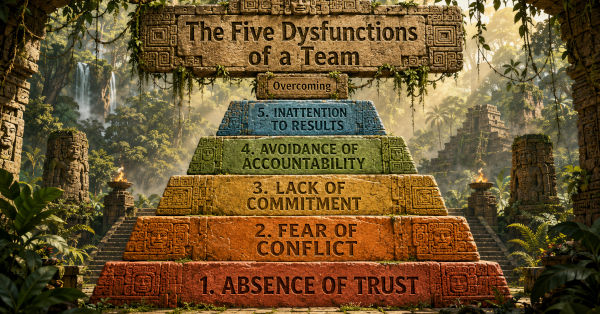
This was an extremely short book. I think the Audible runtime was around 2-3 hours. It began as a narrative story like The Phoenix Project and The Unicorn Project. In the narrative a new CEO takes over a struggling company and has to work through an ineffective and broken executive team. She uses the five dysfunctions to diagnose and correct the ship.
The narrative takes you through a bit of the company before the new CEO Katherine joins, how she works with the team initially, through a phase where the team memberships changes, and essentially stops fairly abruptly. The writing felt a bit juvenile and simplistic, but it was effective at making the points which needed to be made. The book centered on five team dysfunctions and I'll go through each below.
Absence of Trust
Patrick, the author, sees this item as the baseline which fuels the rest. When teams don't trust each other, it becomes difficult to be productive or deliver much of anything. Specifically, it is really hard to be honest, open, and allow friction in conversations and meetings if you don't trust the people involved.
To have hard conversations and drive innovative change you have to have psychological safety which requires a high level of trust.
Fear of Conflict
Fear of Conflict is the second dysfunction. I have already mentioned how teams without trust find it hard to have conflict. Without trust you can't be confident that someone won't take advantage of messy situations. Tough and honest conversations open the door to moments of vulnerability, times when you could be misunderstood, or when you could face negative consequences. This can be scary and trust is required to "sign up" for these situations.
Lack of Commitment
The third dysfunction is Lack of Commitment. This one is a little harder to track down. I think it stems from a couple different directions. First, you tend to not agree with people that you don't trust. Low trust relationships make it easy to find disagreements, misinterpretations, and failures of understanding. Second, I think it can be really hard to assume positive intentions when trust is scarce.
At work we have a saying: "Stay curious." It's meant to remind you to assume the best of people in various situations, but that is difficult when trust is unavailable. Finally, commitment itself requires trust. There must be trust that your partners are going along beside you and pulling together. You need to know that in moments of ambiguity and concern they have your back. You need to know that in remote conversations your interests will still be respected.
Avoidance of Accountability
The fourth dysfunction is Avoidance of Accountability. When you don't feel comfortable committing to a direction, plan of attack, or the team around you then you won't want to be held accountable for outcomes. This lack of accountability is understandable, but poison to teams, delivery, and customers who rely on you. It's critical that people you work with can be counted on to deliver. Or, if they fail you can have an open and honest discussion about it to "right the ship." If your situation allows honest commitment, then usually people are okay with being accountable.
This can be a double-edged sword, however, as once people feel accountable, the commitment and trust must remain high. Failing that, you can lose them both figuratively and/or physically.
Inattention to Results
The final dysfunction is Inattention to Results. If someone isn't feeling accountable for delivery, they are unlikely to be paying any attention to results. When this end of the feedback loop is broken, it can be really hard to get it back working again. Results start to slip and no one is really picking up the slack. The lack of strong results just compound the problems and things continue to spiral.
This final dysfunction feels a little more like an after-effect than a dysfunction. It just doesn't strike me as a dysfunction itself and rather is something that happens when the other dysfunctions are happening regularly.
Negative Cycle
In general, this whole cycle can be a negatively-reinforcing feedback loop that is hard to stop. When trust erodes, conflict becomes scary. Commitment wanes, accountability seems out of reach, and results suffer.
Wrap-Up
This book wasn't bad. It contained some useful information and was packaged in an enjoyable way. It's a super fast read/listen and you can get through it quickly. It did sting a little to burn an Audible credit only to see the listen time was about 2 hours. The author has numerous other books that provide concepts in a narrative style. I would like to read more, but I'll try to find them on Kindle or pay the Audible price directly rather than use credits.