- Published on
TechPoint '26 Keynote: The Chemistry of Innovation
- Authors

- Name
- Josh Haines
The Chemistry of Innovation
Some blog content here.
Innovation is one of those concepts that everyone wants and almost nobody can define. You can't command innovation. You can only create the conditions where it becomes possible. That realization became the foundation of this article and keynote speech.
Introduction & Theme
IMPORTANT
I need to take a minute to thank Justin Johnson from DeveloperTown for his help with the slide deck and these images. He's an amazing designer and Figma wizard and this talk wouldn't have turned out nearly as well without his help.
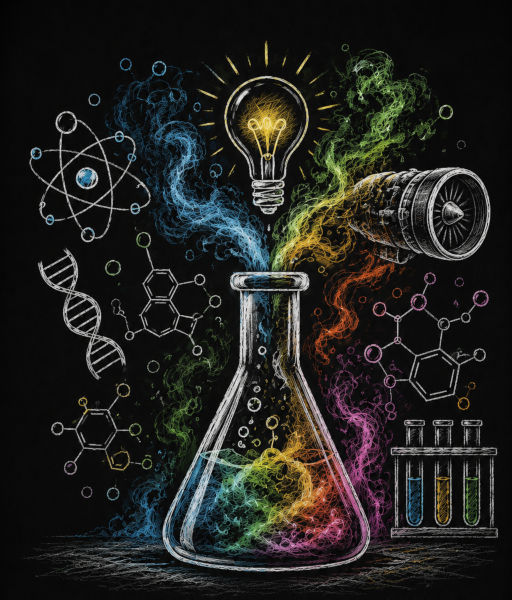
I was asked to give a keynote speech at the 2026 TechPoint Community Connect event related to talent and workforce development, innovation, and AI. As I prepared this talk I realized that nearly every lesson I'd learned about leadership pointed back to some common recurring themes.
- I knew I wanted to touch on psychological safety and how it is the foundation of a high-performing team.
- I've felt for a while that the ability to learn is perhaps the single most important skill in this rapidly changing world.
- I've had this tiny sliver of an idea that has been growing for awhile around the concept of crossing boundaries. It happened to me in my career, although I didn't understand the importance at the time.
I was searching for ways to tie these thoughts together and kept falling back to a recipe. Innovation initially seemed like the result of a baking recipe. If you can put it together in the right way, you'll get a repeatable result.
But, that actually isn't true. It's more like a chemical reaction. You have to set the right conditions, add ingredients, energy, perhaps a catalyst, and then let it happen (or not).
Unlike a recipe, chemistry doesn't guarantee an outcome.
You can't force it, you can only set the stage and hope it happens. This helped me on the way to the title of the talk: The Chemistry of Innovation. The three main sections followed smoothly:
- Experimental Conditions: psychological safety, vulnerability, honesty, trust, etc.
- Add Heat: Provide safe discomfort, challenge, and pressure to ensure learning and struggle are leading to growth.
- Cross Boundaries: Change things up, bring in new ideas, build potential, then release it.
Finally, Indiana has all the ingredients to release the result of the reaction: Innovation. Read on to see the details of each section and some actionable takeaways to help your teams grow and innovate the same way.
Experimental Conditions
The first section is really setting the conditions for our people. We, as leaders, must ensure that the environment our people are working in is fit for purpose, safe, and conducive to the best performance.
9 Brains
use all the brains
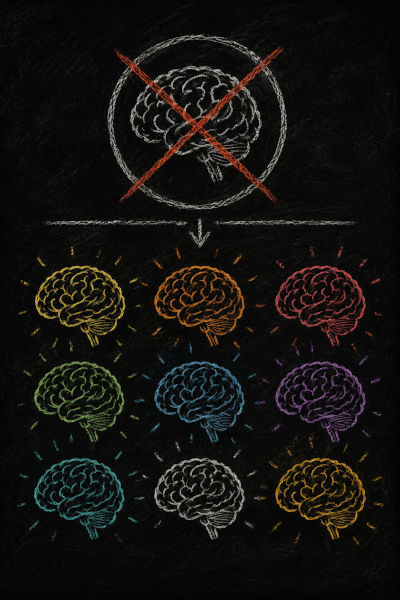
Innovation requires friction. Most organizations optimize for comfort and compliance rather than innovation. In order for people to feel safe enough to create friction and conflict the environment must be psychologically safe. Daniel Coyle in his book The Culture Code explains how psychological safety is the single most important predictor of team performance. I've seen this throughout teams I've led and managed. When people feel safe to put their hand up and disagree with any idea despite the originator, teams begin seeing things that no individual could have seen alone.
If a manager has a team of 8 people and doesn't ensure a psychologically safe environment, the team operates on about 1 brain - the manager's. If you can convince people they are free to challenge ideas, disagree, dispute, and push back then all of a sudden you have 9 brains all pulling together.
If you haven't seen this in action, you might be surprised at how close and familial a team can be while still being ready to jump in and argue with each other at a moment's notice. From the outside it can look chaotic, but from the inside it is an ideal situation. You become free to bring your whole self to work. You can have ideas and push back on others despite your years of experience or time in the role. Good ideas win, bad ideas fall apart. Inside jokes flourish, and everyone is free to shift smoothly between high performance and vulnerability when necessary. Hard conversations don't always get easier, but they do get safer and more productive.
Fragility
leaders decide what survives

A key concept early in this discussion is that there is a large amount of fragility here.
New ideas are fragile.
Junior ideas are fragile.
Honest disagreement is fragile.
Innovation is fragile.
During a time of such fragility, it's often leaders and managers who decide what lives and what dies. This is why psychological safety, honesty, and accessible vulnerability is mandatory for any team seeking innovation.
Every person who joins one of my teams hears some version of the this confersation:
- "I know you're new around here, and I know you're feeling at least some imposter syndrome. That's normal, just sit in it and don't try to escape it."
- "I expect you may think everyone here is smarter than you. You think they may be more experienced, older, and have more reps at the job you're here to do. That may or may not be true, but you're here for a reason. We want you, we need you, and we value you for your input and experience all the same."
- "I need you to have a brain. I need you to challenge ideas no matter who puts them forward. I need you to be brave and ask questions if you are confused, because without that you can't fully judge what you're hearing. I need you to disagree openly if you hear information or ideas you disagree with despite your fear. If you don't, we might miss something. This is not the classic top-down hierarchical team you may have heard about or seen before."
- "Finally, don't let me make you do something dumb. I need you to hold the line and challenge me if I ask you to do something that is dumb or doesn't make sense. I'm one person on a large team and I'm not smart enough to get it right all the time."
The final point comes from a time early in my time of being a manager. I asked one of our grads to make a small change to some python variables in an application. In my mind I was asking him to do a 5-10 minute job to simply align better to our normal standards. It ended up taking him more than 8 hours because of a mixture of him not understanding find/replace, and me not understanding the depth of the correction. He did it without pushing back, and I still feel bad on a normal basis about wasting 8 hours of his time.
Over the years I've come to believe leaders can't empower people. People are already capable and able to make change on their own. Leaders simply decide if that capability will be encouraged or suppressed. The same is true of innovation. In a similar way leaders can't create innovation. They simply create the conditions where innovation emerges and flourishes.
Books
If this section resonated with you, these are the books that most shaped my thinking.
- Daniel Coyle - Culture Code: This book really taught and convinced me of the importance of psychological safety and how it's the foundation of a high-performing team.
- Amy Edmonson
- The Fearless Organization : This book is a deep dive into how to implement psychological safety in your team or organization. I've leveraged many of the practices in this book and have seen great results.
- The Right Kind of Wrong: This book acts as a manual for teams and leaders to understand the key role of failure in an organization and how to do it in the right way to learn, grow, and deliver at pace.
- Brené Brown
- Daring Greatly: A solid book which introduces concepts around vulnerability as power, humility, working through shame, removing your armor, and being brave.
- Dare to Lead: In this book Brené expands on the previous work and applies it to leadership. She introduces the concept of Rumbling with hard topics, daring vs. armored leadership, and how vulnerability tolerance predicts leadership capability.
- Strong Ground: In her newest book Brené builds on her work on bringing the Dare to Lead topics to large organizations. She expands, refines, and sheds new light on implementations and how leaders can be even more impactful while remaining curious and daring.
- Kim Scott - Radical Candor: This book teaches you to be open, caring, honest, and rigorous in how you have all types of conversations
As we look towards the next section there is one key question and it's answer to have in mind:
Q: Once people feel safe enough to think, how do we help them to learn and think better?
A: Turn up the heat!
Add Heat
In many chemical reactions adding heat increases the reaction rate. For people, the equivalent idea is discomfort. Challenge, uncertainty, and struggle while avoiding anxiety, exhaustion, and fear will accelerate learning.
Escalator Moving Backwards
if you aren't running, you're moving backwards
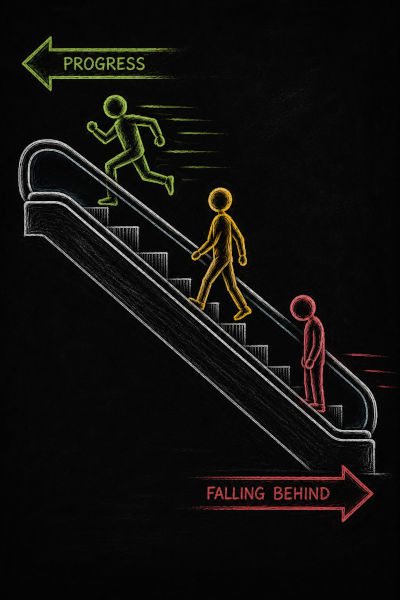
Imagine you're facing up on an escalator that is moving backwards.
- If you stand still, you're riding it down.
- If you walk upward at the same speed you remain in place.
- If you run upwards then you'll make some progress.
This is the world we seem to now be living in. Information is changing at such a pace that you must be constantly learning just to avoid getting behind. If you want to get ahead you must learn even faster. In many fields, the escalator appears to be accelerating.
Learning itself is now the competitive advantage. With the speed of change and the capabilities of AI, information retrieval is much simpler. Learning velocity is becoming more valuable than the knowledge itself. Synthesis of information remains a human skill while retrieval of information is starting to be outsourced to models and tools. Becoming competent at synthesis of information takes time, effort, and deliberate training.
One of the special things that I see working in the software world is that information and tools are changing so fast that years of experience is no longer the key question for capability. During a discussion, the person with the most relevant insight may be the one who asked AI the right question that morning or watched the right explanation the night before. This can be ego crushing, but also thrilling. The ability to adapt, learn, and be open to better ideas from all angles is driving our pace and performance. I'll often mention how a combustion engineer with 20 years of experience is almost always more knowledgeable and capable than a combustion engineer with 2 years of experience. In tech, that is wrong as often as it's right.
Finally, I think it's critical that everyone understands their learning stack. This is the common methods, tools, knowledge sources, and practices that help them learn at their best and fastest. I ask this question during interviews and the best people I've found understand the idea immediately (even if they've never heard the phrase) and then chat openly about the ways they consume information and learn new skills. When people are confused about the phrasing or don't have a good story once they understand the question, it often means they aren't spending much time in the uncomfortable place of learning.
Keeping pace requires continuous learning, but learning only happens when we move beyond what we already know. That means spending time in discomfort.
Discomfort is the Way
learning happens in the struggle
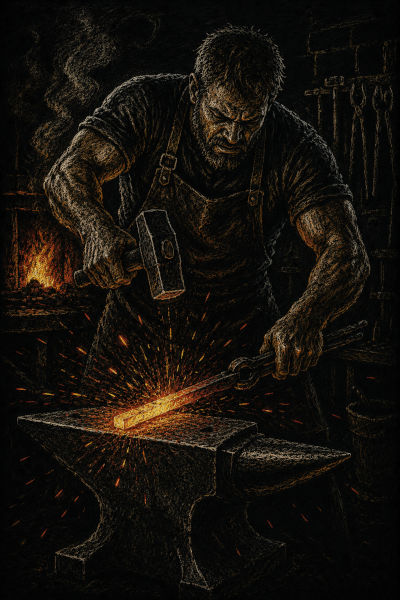
After working with nearly 150 early-career professionals across our teams, I have seen repeatedly that learning happens in the struggle. Some people become uncomfortable after only a few minutes and immediately reach for an exit. They ask a senior colleague, ask AI for the answer, hand the task to someone else, or simply give up. Each of those escapes may solve the immediate problem and relieve the discomfort, but it also cuts the learning process short.
Struggle tolerance and resilience leads to better outcomes. Successful people tend to be those who allow themselves to remain confused the longest. Some people have a natural struggle tolerance of 15-20 minutes, others are happy to grind for 8 hours. Both groups can be successful if they practice the habit. A key point: you want to escape before it turns stressful and hurtful. We've found you should go to the limit where solving the problem still feels good. If solving the problem makes you want to cry, you've struggled too long.
Productive struggle does not always look like grinding harder. Some problems respond to concentration, others respond to distance and time. Cal Newport is famous for his book Deep Work that describes methods for solving hard problems with direct thought and activity in a deeply focused way. This works well and is an invaluable method for some problems. Chris Bailey takes this further in Hyperfocus and also talks about the flip side of the coin: scatterfocus. Some problems can't be solved with directed, focused attention. Using scatterfocus to support your brain in its non-linear efforts can also be powerful. Everyone reading this has likely had a "Eureka!" moment in the shower, on a walk, or on a commute home. Learning to harness this non-linear problem solving tool really fills out the problem-solving toolkit. Knowing when you should grind and when to wander is a critical part of learning to solve hard problems.
Books
- Carol Dweck - Mindset: Carol lays out the concepts around a growth vs. fixed mindset and how empowering belief in your own growth can be.
- Cal Newport - Deep Work: Learn how to go deep on problems and focus for impressive results.
- Chris Bailey - Hyperfocus: Go further on your struggle journey and learn the non-linear problem solving tools with scatterfocus.
- Daniel Kahneman - Thinking Fast and Slow: A classic and well referenced book on the two ways our minds make decisions and think through problems.
- Adam Grant - Think Again: Adam teaches how to rethink previous decisions and opinions to make your opinions more loosely held.
We now have people who feel safe enough to think, and who know how to learn. The next step is to expose them to new ideas and situations that can release their potential.
Cross Boundaries
Safety lets people contribute. Productive discomfort helps them grow. Innovation also requires new combinations. Next I'll discuss how we build potential through varied experience, then release it by moving people across boundaries.
Build Potential
you don't know what matters yet

One of the books for this section, Range by David Epstein, discusses the paths to greatness by two contrasting athletes: Tiger Woods and Roger Federer. Most of us have seen videos of Tiger Woods hitting a golf ball when he was just a toddler. He has been passionate about golf from the time he was little and eventually became the best in the world. Roger Federer had a different path and played many different kinds of sports until picking up a tennis racket relatively late. He is an athlete who built a general athletic background and later applied it to tennis. Tiger's path is memorable, but Federer's broader path is a far more common path of success across complex domains.
Specialists tend to optimize solutions while generalists connect things together. When people build decades of experience in a single field they end up accumulating knowledge, problem solving experience, as well as limitations accepted as barriers. In a world with powerful AI models, that knowledge is not as valuable as it once was. The experience is still valuable, but it comes with a cost in the form of patterns and assumptions. People long in experience in one domain sometimes innovate slowly because it becomes hard to challenge the assumptions around status quo. We need fresh eyes on existing problems. We need people unfamiliar with accepted barriers to innovation.
Taking someone with a lot of experience in one area and moving them to a new area changes the game. In this position they don't have the knowledge, but they still have their experience and pattern recognition. They don't have the field or domain-level assumptions and knowledge of roadblocks and barriers. They inherit the list of questions, not assumptions as before. Every new experience turns into another ingredient on the shelf. You don't know ahead of time which ones will matter later, so building a varied shelf increases the possibilities.
Be the Catalyst
movement releases potential energy

I had this kind of switch in my career about 7 years ago, although I didn't understand the implications at the time. I had already spent about 13 years as an engineer across two domains (aerospace and construction products) and multiple roles (failure analysis, materials and process engineering, reliability engineering, supply chain audits, depositions and litigation support, etc.). I then pivoted and began essentially a software consultancy start-up inside of the Rolls-Royce enterprise. I was nervous because this was a complete switch across fields and domains, but I also understood the problem I needed to solve deeply and I had years of experience solving hard problems. This new challenge didn't seem insurmountable. Over the next few years I developed many first-of-their-kind tools, methods, and processes which were new to not only Rolls-Royce, but new to the entire Defense Industrial base (DIB). I can now see that part of the advantage was that I did not bring the assumptions of someone who had spent an entire career in software. I was essentially a Sr. Intern with 13 years of engineering experience.
Another example of this was when Amazon hired someone from us who had spent time in manufacturing engineering. After discussing with the people who left, it was clear that they were hired for diversity of thought and experience. This person had spent a lot of time solving problems in a different domain. Software skills can be taught. Fifteen years of solving physical, operational, and manufacturing problems cannot be compressed into a short training program. By dropping one of these people on a highly productive software team, they were a catalyst for solving problems in new ways. They provided fresh eyes, deep experience, but no assumptions as to "what was allowed." When they stepped up to the whiteboard things went in new and interesting directions.
By moving to an area where you don't have the baggage of norms, historical solutions, or accepted solution patterns you can challenge and support new styles of solutions and unlock innovation. In chemistry, a catalyst doesn't create energy. It lowers the barrier that prevents the reaction from occurring. Maybe careers work the same way. Maybe organizations work the same way. Instead of training people harder, perhaps we should move them around more. I think innovation isn't something leaders can create. It's the release of potential that was already there.
Books
- Mark Schwartz - Delicate Art of Bureaucracy: Navigating bureaucracy is a critical skill so people can better act as change agents.
- Annie Duke - Quit: Learn how changing paths can create room for new ones.
- David Epstein - Range: Scientific backing that generalists succeed more often than specialists, and how to leverage this in your career.
- Colin Bryar - Working Backwards: Learn how to transfer principles from Amazon's context to your organization.
- Reed Hastings - No Rules Rules: How to challenge accepted organizational assumptions.
If we can support our people this way, Indiana is unusually well positioned to put the framework into practice.
Indiana: We Have the Ingredients
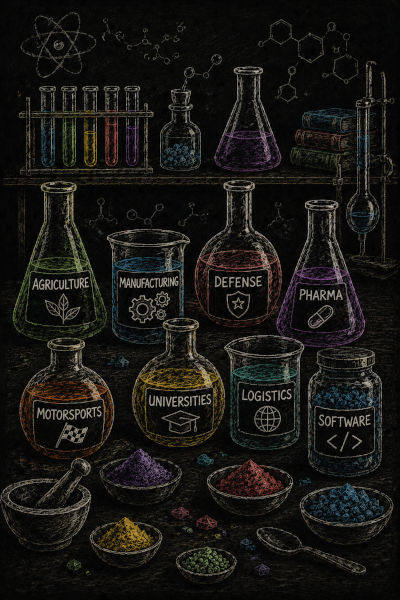
As a community of leaders driving innovation in Indiana, we need to set the conditions with stronger leaders, managers, and interactions. We need to add heat by ensuring our people can learn better and faster while leveraging our universities and partnerships. We need to release our potential by colliding people, ideas, and industries across our organizations.
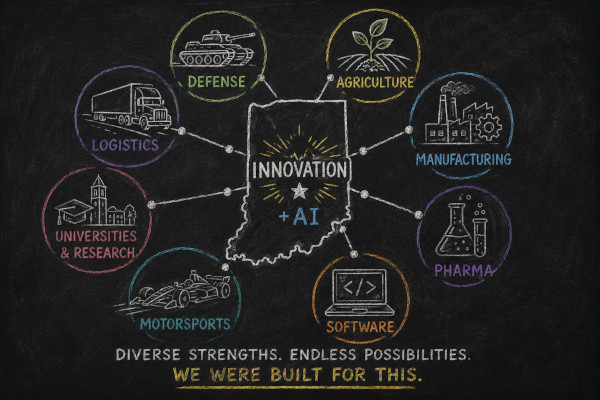
Indiana has an extremely diverse industrial ecosystem. We have defense, agriculture, manufacturing, start-ups, big pharma, motorsports, top universities, logistics, and software all around us. Most regions would love to have even half that diversity and capability in such a small area. We already have the pieces, but we often treat them as separate ecosystems. We need to collaborate and mix together more effectively. That feels like innovation. That feels like progress. This leadership community is in the prime position to ensure that happens.
Let's work to raise the tide which will raise all ships from small tech startups to multibillion-dollar enterprises, together. Let's start increasing the collisions of people, industries, and ideas.
Imagine the impact of experiments based on these ideas:
- What if we took a senior power engineer from Cummins and dropped them into a Pharma pilot lab at Eli Lilly for three months?
- What if we took a High Alpha entrepreneurship expert and gave them a six month placement in middle management deep in the bureaucracy at IU Health?
- What if we brought a fast moving prototype design engineer from Dallara or Andretti motorsports and put them in a Rolls-Royce design team on our traditional or legacy engine programs?
Our universities already have industry partnerships. What if we, as leaders, strengthened those partnerships with ways to bring professionals back to the classroom to work on projects alongside students. The goal wouldn't be delivery of results as much as allowing students to see how an industry professional approaches problems, thinks through sticking points, etc. The professional would also benefit from fresh perspectives and newer tools.
Our large employers should be looking for ways to leverage their senior problem solvers into other places to do more good. In return, they could have other experts from other organizations lend a hand on their hard problems. As long as IP considerations are handled properly, this would be a win in all directions. Our organizations could also get benefits from expanding rotational programs into mid-career such that the people on rotations have many years of problem solving experience. A Sr. Intern program could leverage some of the power of the model discussed above.
Engineers and problem-solving leaders in these communities should be looking for ways to recognize when youa re accumulating expertise versus applying it somewhere new. It takes both sides of the coin, but being clear-eyed on which phase you're in can make a big difference in maximizing your contributions.
TechPoint is uniquely positioned to facilitate sharing of people and experiences across domains while protecting IP and benefits for companies. They are uniquely positioned to both clearly explain the benefits of thinking outside the box on these topics as well as facilitate the activity to make it a reality. What if they had a brokerage where companies could contribute weeks or months of their experienced people and in return get other people with experience to help on their tough projects?
Indiana already has enormous potential energy. Now we need leaders willing to create the conditions, add the heat, and increase the collisions that release it.
Continue the Experiment
In the talk, I linked to this long-form version so people could go deeper and continue the conversation. I'll keep this updated with links, discussions, and support for people wanting to continue this good work. Feel free to reach out to me at the links on the About Me page.
You can find my entire book shelf to see my list ordered from most useful to least useful (according to my gut-feel ranking system.)
If you use any of the content in this blog post, slides, or book write-ups, I'd love to hear about it as I'm passionate about this work and it would be great to hear how people are using it.